
Why Single Out Nidal Hasan for Execution?
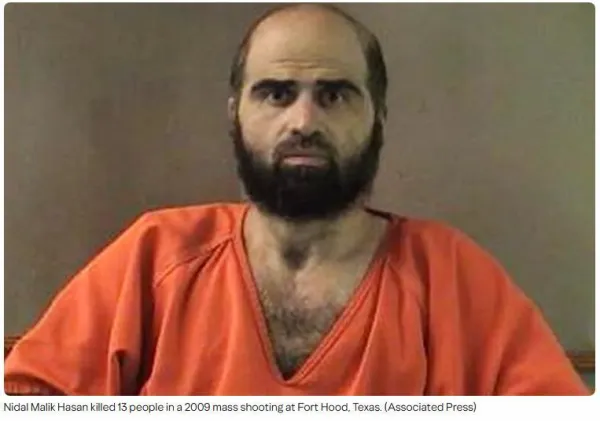
U.S. Army Maj. Nidal Hasan, convicted of murdering 13 people and attempting to murder 32 others in the 2009 Fort Hood shooting, is scheduled to be executed by firing squad on December 3. Although Hasan is incarcerated at Fort Leavenworth, Kansas, the execution is scheduled to take place at Fort Hood, Texas.
Defense Secretary Pete Hegseth proposed livestreaming the execution, arguing that the public should see the consequences of such crimes. President Donald Trump later reversed that plan following bipartisan criticism, but the execution remains scheduled.
Choosing Fort Hood as the execution site raises a troubling question: Is this simply about carrying out a sentence, or is it about turning death into a public spectacle? Broadcasting an execution would be barbaric.
Two things about the Fort Hood shooting have stayed with me.
First, a local mosque invited me to attend a press conference and speak about the shooting as a retired military veteran. I gladly accepted.
Second, I still remember Dan Ross, a Florida man, Vietnam veteran, and Christian who tried to send Hasan a bouquet of yellow roses while he was hospitalized. Ross requested a custom card reading: “In God's eye, and those who submit, you are a hero!”
The Texas flower shop owner refused to complete the $59.95 order and instead reported it to the Army base and the FBI. FBI agents later visited Ross's home, although federal officials declined to comment on the investigation.
Ross told local media that he believed in loving one's enemies and hoped the incident might lead to positive outcomes, including an end to religious conflict. He also said he had children serving in the military and wanted to reach out as a gesture of respect.
Source: CBS News.
I reviewed the Army's 2026 legal overview, which identifies four prisoners currently on U.S. military death row. Their cases include:
1. Ronald A. Gray
Convicted of murdering two women, attempting to murder a third, and committing sexual assaults while stationed at Fort Bragg, North Carolina, in the 1980s. He was sentenced to death by a general court-martial.
2. Hasan K. Akbar
Convicted of murdering two military officers and attempting to murder other service members in Kuwait in March 2003. He was sentenced to death in 2005.
3. Timothy B. Hennis
Convicted of murdering an Air Force captain's wife and their two young daughters in North Carolina. He was sentenced to death in 2010.
4. Nidal M. Hasan
Convicted of murdering 13 people and attempting to murder 32 others at Fort Hood in 2009. He was sentenced to death in 2013.
The question is not whether Hasan's crimes were horrific. They were. The question is why his execution is moving forward now while three other prisoners remain on military death row.
Has the government applied the same standards to all four cases? What explains the decision to proceed with Hasan's execution at this time?
The government owes the public a clear explanation. And given the climate of anti-Muslim prejudice in America, it is fair to ask whether Hasan's religion played any role in the decision.
The Pentagon announced on Oct. 5 that Trump had approved Hasan's execution by firing squad at Fort Hood. Pentagon
officials subsequently told the Associated Press that the execution, due to take place on Dec. 3, would be livestreamed.